reser.ch
Better web search in 2026.
Google Sucks
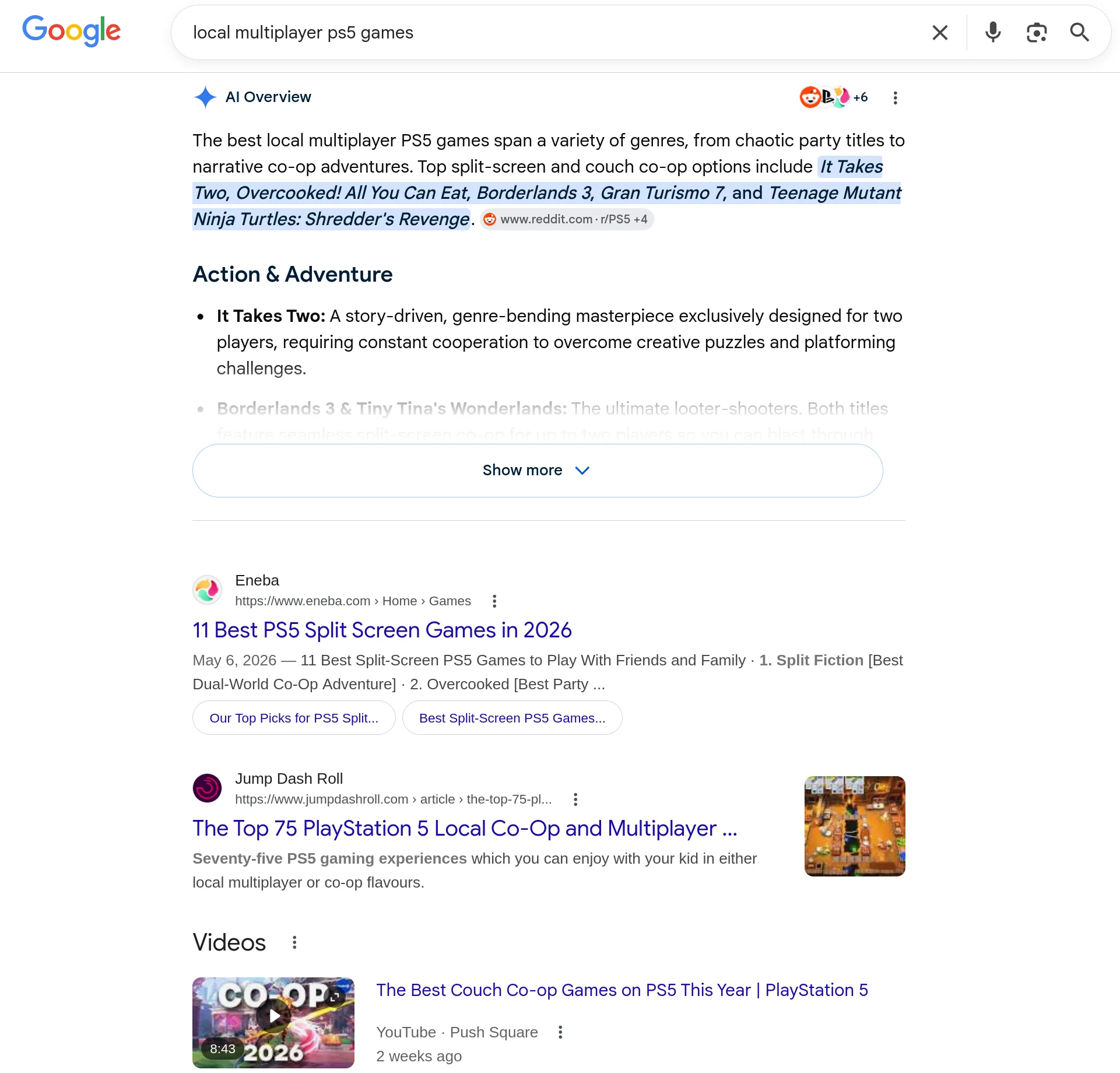
Recently I’ve been very frustrated, as are many online, with the state of Google Search. Signal to noise on the web is awful right now. AI Slop means more noise and less signal. I think it is an entirely obvious and evitable bad outcome, to deprioritize the tech and tools that spawned your customer’s love; and to contribute to tools that pollute your bottom line.
Early in my scientific education, I had experiences using books nobody else had on hand, in an academic library and without an experienced librarian my research would have been stymied by poor information access.
The modern internet is so much bigger than a building could hold, than a librarian or information systems architect could feasibly service without great, reliable supporting tools and infrastructure - like a full web search. Google was revolutionary at one point, the lynch-pin idea making the information superhighway dream more super than high…
But along with every other AI sycophant they’ve made their decisions. This hurts. All of us still need reliable information access. I am not saying I solved that problem, but I did attempt to do this in a way that works for me.
Enter Reser.ch

As any trigger happy hyped up founder developer motherfucker - I bought a punny domain name first. Something punchy to where you can type it quick. I was surprised when I found this available, though it required my usual super power of toothless misspelling.
As with all of my UI thinking, I like simple and quick branding. I whipped up a basic readable black and white modern site, and then I hit the usual problem - to what do I bolt this?
While struggling with Google I looked at Kagi, I looked at DuckDuckGo (whom I love!) and I looked at old FOSS projects. I found SearXNG - and was very impressed that I could set up a docker container to “just fire some requests”.
I went to Railway, which I love as a deployment platform because it’s easy to enter in maintained public Docker images to “just ship.” And I thought about system architecture for a basic search tool:
- We need a portal UI. Covered.
- We need an API of some sort to get search results. Covered.
- How do we handle relevancy and ordering?
No Bullshit AI Solutions
That last bit took some thinking. I needed a basic backend with an algorithm. I am fully against enshittification. I could feed in every user query set of results to OpenAI or some nonsense that costs us all more money and time, label it as “agentic web search” collect my cheque from shit head VCs, pass go, sell all the query data…
Or I could use my ML and AI brain to come up with a basic solution that isn’t fucking awful, gross, overkill, wasteful, and stupid! I’ve been building solutions with AI well before the answer slot machines existed. Let’s go!
First question - what’s the real problem here?
The results are decent in the top 100 from pretty much any source, eyeballin’ it - but they aren’t in an order that makes it really relevant.
PageRank, what Google got famous for, was a core algorithm to provide for mass manufactured relevant search back in the day - its inputs are generally hyperlinks and hyperlink counts to determine richness, and therefore ordering of content. Originally the core algorithm is non-content based - it doesn’t consider the words other than links; though I am sure it has evolutions where TF IDF was wrapped in etc.
(N.B. - Modern search ranking comes from 1 term of content weighting via something like BM25 + 1 term of list rank weighting via something like PageRank, if you want to read for curiosity say: Wikipedia)
I could implement that. I am sure SearXNG, as a meta search project, uses some kind of cross scoring like reciprocal rank fusion, to weave together results delegating some of the weighting to the original search APIs…
But I just didn’t find it compelling. The problem with DuckDuckGo, based on Bing IIRC, and also Kagi when I tried it (and I cannot prove it but I believe it’s very similar to SearXNG under the hood…) - was that there were hits in the top data returned but they just didn’t have the immediate “this is what I want” sensation that Google did.
There is an easier way to fix that I felt… LLMs are weird and ick-ily made but they are great text rerankers and a small one can do that job without much fuss. People forget that LLMs don’t just generate text, but help with NLP tasks - you can classify using them therefore you can kind of “slot fill” and given 10 results, figure out which is most relevant.
In fact, within the space of FOSS AI there are great text reranking language models immediately useable on HuggingFace, off the shelf. Small enough to where it runs privately on node, without much fuss.
So then… you mean - I don’t even have to get a larger LLM, generate synthetic data using spaCy and train a specific solution to do relevancy reranking? Sign me up. I don’t like modern GenAI or LLMs precisely because the stupid corporate money shell game that produced them concentrates wealth and attention away from the core, crux of cleverness within the field of AI. We can do better, privately, and nicely. So I did!
Reser.ch Architecture
Essentially we arrive at:
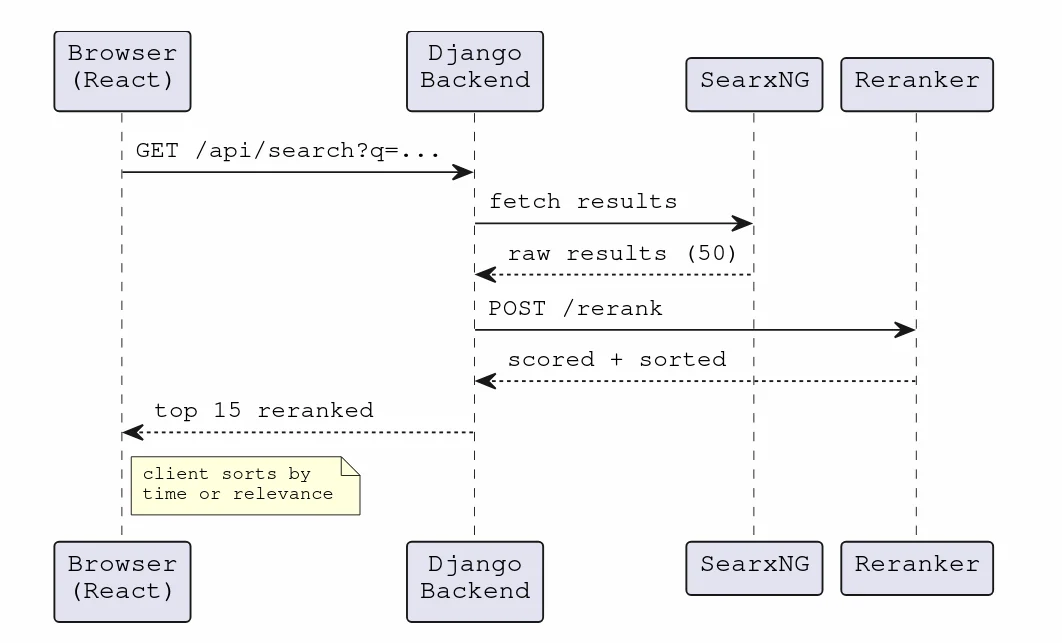
This means we can serve basic search requests using SearXNG to get results, and reorder them by relevancy in text payloads to get a pretty decent experience. The small LLM based reranker we use sorts after fetch, and the client side is what handles the date sort in the global result set for speed and avoiding refetch.
Additionally, SearXNG affords us category search which is useful for scholarly and legal documents very nicely as well, no extra work. If I was so inclined, I could allow a multimodel reranker to be used to help sort images as well - though I think a weak point of my UI here that I didn’t address with a fast project were the cards and visual structure for video and image search.
Reser.ch Performance
This isn’t scientific but I benchmarked it informally with a few queries:
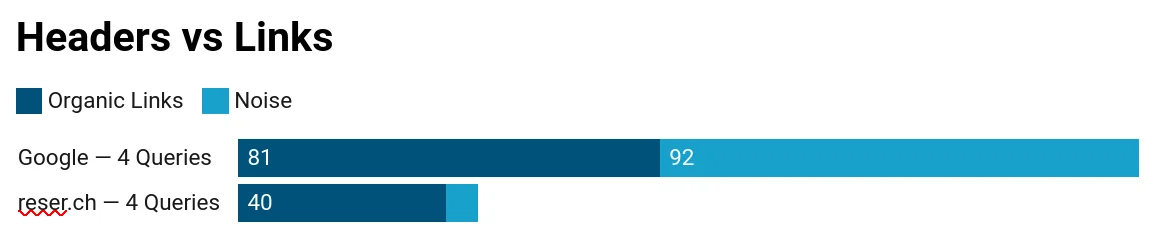
I found that results are useful generally, even without reporting the full F1, precision, recall at top_k 10 here, you can try it out for yourself. You don’t need custody of every page on the web to write PageRank and maintain a great result order - you don’t need Gemini or big AI, you really can do a lot with a little nowadays. If Google Search was rebuilt all over again I’d be curious to see how they launch a competing MVP that is in fact less cluttered, and better given my experience here.
What did I use it for?
Well I wanted to find games to play with my wife on PS5. We had played pretty much everything in the genres we like, local multiplayer, co-op or competitive, 3rd person, platformer…. I thought I’d exhausted our options.
I found a blog written recently. Using my “recent order” feature, it was actually useful! I found new games! I haven’t had that experience on Google in years. Yes - the same article can be found on Google of course, but for the same simple query it did NOT give me an answer.
Yes, search is not reinvented, I am not the great disruptor, but I think in 2026 it’s easier than ever to build your own basic tooling. The joy of this was nice. I feel liberated from big tech bit by bit. It’s a public search engine now so go use it and enjoy. Maybe you feel that liberation too?
And the kicker - NO sponsored bullshit. NO genAI crap results. 10-15 high quality search answers - where the SEO depends on the quality of the written content, and not payment or games. Simple, clean, zen search.
This was genuinely a great experiment for me, and made me feel empowered. I use reser.ch daily and between that and DuckDuckGo I have nice, simple, private, less noisy search for most of my asks.
Next Steps
I want to make this open source so anyone can see the stack. I want to also display my hosting costs on Railway on the About Page so if you do find my “neo search engine” useful and simple to your life, you can donate to keep it funded :)
If many people use this and find it useful, I’ll probably spend more time improving it as well, so that it can support higher load and just be more generally accessible and fun.
Enjoy and keep building! You can make nice things too, that solve your own problems, in 2026, and help others keep the web a zen place for normal, non corporate human beings :)